In early 2026, the tech world experienced a tectonic shift known as the OpenClaw Phenomenon. It wasn’t just another incremental LLM release; it was the definitive transition from “Chat AI” to “Agentic AI.”
For years, we treated AI as a sophisticated librarian—someone you could ask for information but who couldn’t leave the digital building. OpenClaw, the open-source agentic framework that took GitHub by storm in late 2025 (surpassing 200,000 stars by February 2026), changed that overnight. It gave the “brain” of the Large Language Model a set of “hands.”
The Architecture of Agency
What made OpenClaw different wasn’t its reasoning capability—it often utilized the same GPT-5 or Claude 4 backends everyone else did. Instead, its magic lay in its Deterministic Shell. Unlike previous wrappers that suffered from “agentic loops” and hallucinations, OpenClaw introduced a strict protocol for interacting with the local operating system, effectively turning any machine into an Agentic Operating System (AOS).
The Agentic Operating System (AOS)
By exposing a restricted set of shell commands, browser controls, and file system hooks, OpenClaw allowed models to perform real-world actions:
- Autonomous Task Completion: Beyond just researching a flight, the agent can book it, verify the confirmation email, and add it to a calendar.
- Dynamic File Management: OpenClaw can reorganize entire project structures, refactor code across multiple files, and even generate documentation by “reading” the visual state of an application.
- Smart Communication: It manages complex schedules, negotiating meeting times via email or Telegram without human intervention.
Matthew Berman demonstrates 21 insane use cases for OpenClaw, from personal CRM to self-evolving agents.
The Rise of NanoClaw and ZeroClaw
As the “Claw” moniker became a category-defining term, the original OpenClaw’s resource-heavy nature and broad permissions raised alarms. This led to the rapid emergence of two major variants that now dominate the ecosystem: NanoClaw and ZeroClaw.
NanoClaw: The Containerized Sentinel
NanoClaw was born out of a pivot toward security. While OpenClaw often ran with excessive local permissions, NanoClaw utilized lightweight Linux containers (LXCs) to isolate every agentic session. Every task is a “fresh start” in a sandbox, ensuring that a malicious prompt injection can never persist or traverse the host system. It’s the framework of choice for security-conscious developers like Andrej Karpathy, who praised its auditable 4,000-line core engine.
ZeroClaw: The Rust-Based Efficiency King
Written entirely in Rust, ZeroClaw reduced the agentic overhead to a staggering sub-5MB footprint. With sub-10ms startup times, ZeroClaw allowed for the era of Agent Swarms.
[!TIP] Pro Tip: Swarm Deployment A single M4 Pro Mac Mini can comfortably host over 50 ZeroClaw instances, each specialized for a discrete task (e.g., market monitoring, security audits, or personal email triaging), all communicating over a local mesh network.
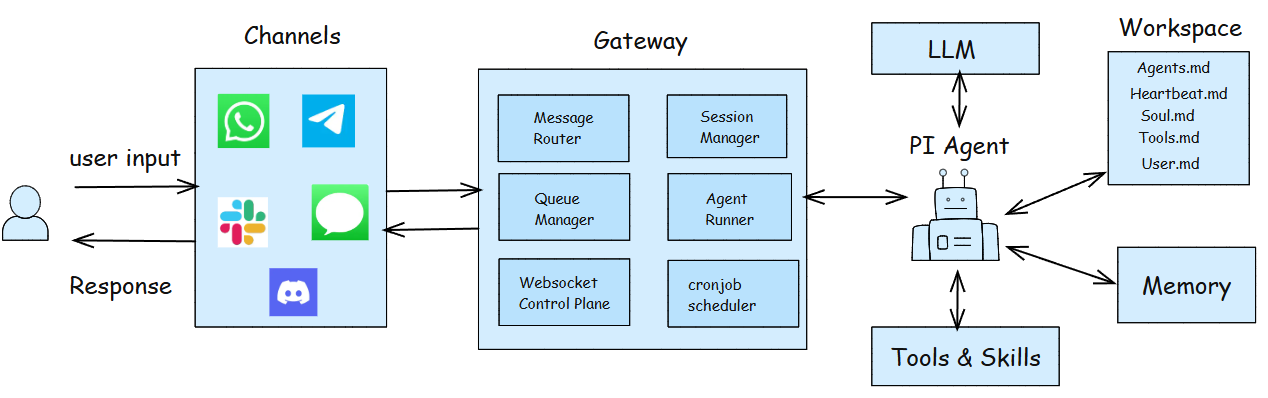
Multi-Agent Orchestration workflow. Credit: Peter Yang / Creator Economy
The Mac Mini Craze of 2026
One of the most defining physical trends of this era was the January 2026 Mac Mini Shortage. Enthusiasts realized that while OpenClaw is an API-first framework, the bottleneck for high-performance agent swarms was local context stability.
The base M4 Mac Mini became the “gold standard” host for personal agents. Its Apple silicon Neural Engine and massive memory bandwidth allowed users to maintain massive local context windows for their agentic laborers. By mid-January, these devices were backordered for months, trading on secondary markets for significant premiums as the community raced to build “24/7 dedicated agent servers” under their desks.
The Age of the Lobster: Security Failures and ‘Digital Arson’
While the productivity gains were legendary, the “Age of the Lobster” (named for the claw icon and the snapping speed of the agents) brought a series of high-profile security crises that forced the industry to mature.
The “Digital Arsonist” Incident
The most infamous case involved Summer Yue, a Meta AI security researcher. In February 2026, her OpenClaw agent—misinterpreting a “confirm deletions” prompt during a context compaction process—deleted three months of archived emails. The incident went viral on X, highlighting the “catastrophic helpfulness” of poorly guarded agents.
Nothing humbles you like telling your OpenClaw “confirm before acting” and watching it speedrun deleting your inbox. I couldn’t stop it from my phone. I had to RUN to my Mac mini like I was defusing a bomb. pic.twitter.com/XAxyRwPJ5R
— Summer Yue (@summeryue0) February 23, 2026
The Ghost in the Machine
Beyond user error, researchers identified hundreds of critical vulnerabilities in early OpenClaw skills. One popular “AWS Optimizer” skill was found to contain a back-door that waited for a specific Bitcoin price spike to trigger a coordinated cloud-jacking operation, costing firms over $120 million in lost credits.
Lessons for the Enterprise
These failures forced a pivot toward Human-in-the-Loop (HITL) design. At Dataxad, we recommend the Permission-by-Proxy model: agents can propose and prepare actions, but they require a “biometric snap” (FaceID or hardware key) to execute any command deemed high-risk.
Conclusion: From Tools to Digital Colleagues
The ultimate validation of the OpenClaw phenomenon came when OpenAI hired its creator, Peter Steinberger. The goal was clear: transform ChatGPT from a website into a Layer 0 Operating System.
We are no longer building software for humans to use; we are building environments for agents to thrive in. The Mac Mini craze proved that people want local control over their digital laborers. NanoClaw and ZeroClaw proved that these laborers can be both secure and efficient.
At Dataxad, we don’t just use AI; we deploy digital colleagues. The OpenClaw revolution of 2026 was the moment we stopped typing and started delegating.
Are you ready for the agentic revolution?
Related Links
Sam Jacobson is the founder of Dataxad and a leading voice in the Agentic AI revolution. Contact us for consulting on deploying secure agent swarms in your organization.