Anthropic launched Claude Fable 5 on June 9, 2026. Developers quickly began testing it on long-running software work, research, and tool-heavy tasks.
Three days later, access disappeared.
Anthropic suspended global access to Claude Fable 5 and Claude Mythos 5 after new US export controls took effect. The company said it could not reliably verify nationality in real time, so it took both models offline while it worked through the restriction.
The interruption exposed a familiar architectural weakness: if a critical workflow depends on one hosted model, the vendor’s policy, infrastructure, and legal constraints become part of your own reliability envelope.
Anthropic restored global access on July 1. That does not erase the lesson. It makes the lesson more useful: local AI is not an ideological substitute for cloud AI; it is one way to build a credible fallback.
The Three-Day Reign of Claude Fable 5
Before the suspension, Fable 5 attracted attention because it could sustain longer and more complicated tasks than earlier Claude models.
In standardized benchmarking, Fable 5 achieved a historic 91/100 on senior-engineer software development tests, whereas the best performing models from early 2026 struggled in the low 60s. Armed with a 1-million-token context window and an architecture designed from the ground up for agentic execution, Fable 5 was acting as an active, stateful collaborator rather than a passive completion engine.
Across YouTube and Reddit, developers shared ambitious workflows:
- Autonomous Video Factories: Creators showed Fable 5 taking raw footage, script files, and audio, and completely orchestrating the video editing pipeline—including precise cuts, color grading, and titles—using CLI video tools.
- Unity & Game Engineering: Software developers documented the model building functional 3D game mechanics in Unity from a single prompt, writing complex C# scripts, structuring components, and debugging its own compile errors.
- Slack-Integrated Software Factories: AI-native startups shared workflows where Fable 5 monitored Slack channels for bug reports, located the buggy code in GitHub, ran local tests to reproduce the issue, wrote a fix, and submitted a pull request autonomously.
Anthropic also published SWE-Bench Pro results. Benchmarks are useful context, but they do not guarantee the same performance on a particular codebase.
| Model / Agent Harness | SWE-Bench Pro (Pass Rate %) |
|---|---|
| Claude Fable 5 | 80.3% |
| Claude Mythos Preview | 77.8% |
| Claude Opus 4.8 | 69.2% |
| GPT-5.5 | 58.6% |
| Gemini 3.1 Pro | 54.2% |
Then the endpoints began returning 503 Service Unavailable and 403 Forbidden. Whatever the benchmark score, unavailable software has a pass rate of zero in production.
The Vulnerability of Cloud Dependency
The fallout on platforms like r/ClaudeAI and r/Anthropic was immediate. Developers who had spent sleepless nights refactoring their core products to leverage Fable 5’s massive context window and reasoning loops found themselves locked out.
Anthropic later explained that the government order took effect immediately and that it had no reliable way to verify nationality in real time. Teams actively testing tool-using workflows lost access without a migration window.
The incident highlights three ordinary—but consequential—risks in a cloud-only AI architecture: availability, data handling, and cost control.
| Metric / Feature | Centralized Cloud APIs (e.g., Fable 5) | Sovereign Local AI (e.g., Qwen 3.6 / Llama 3.3) |
|---|---|---|
| Operational Control | Vendor outages and policy changes are outside your control | You control deployment; hardware and operations remain your responsibility |
| Data Privacy | Prompts and context cross a third-party boundary | Data can remain inside your environment if the full pipeline is configured accordingly |
| Cost Model | Usage-based pricing can become unpredictable | Upfront hardware plus electricity, maintenance, and staff time |
| Latency | Network-dependent roundtrips | Hardware-bound (highly optimized with local runtimes) |
| Customizability | Limited to system prompt adjustments | Complete custom fine-tuning and parameter adjustments |
The Blueprint for a Sovereign Local AI Strategy
At Dataxad, we advise our clients to build resilience directly into their technological foundations. A sovereign AI strategy does not mean completely abandoning the cloud; it means adopting a hybrid, local-first model that guarantees business continuity.
1. Data Sovereignty and Compliance
Running open-weights models on your own servers or private cloud can keep prompts and model context inside your security perimeter. For regulated or sensitive work, that reduces the number of external systems involved. It does not replace access controls, encryption, retention policies, logging, or human review.
2. Predictable Marginal Cost
An agent may call a model dozens of times to finish one task. In a cloud-centric setup, that can produce unpredictable API bills. Local inference removes per-token billing, but it is not free: the costs move to hardware, electricity, cooling, maintenance, and engineering time. For steady, high-volume workloads, that trade can be attractive.
3. Local-First Infrastructure
Setting up local inference is no longer the complex headache it was a few years ago. Tools like Ollama and LM Studio provide single-command installations that package open-weights models into local servers. For enterprise-scale deployments, open-source runtimes like vLLM allow teams to host OpenAI-compatible API endpoints on private clusters, enabling drop-in replacements for cloud endpoints.
Choosing the Right Local Hardware and Models
To run a high-performance local AI node, you need to understand the relationship between model architecture, parameter size, and hardware memory.
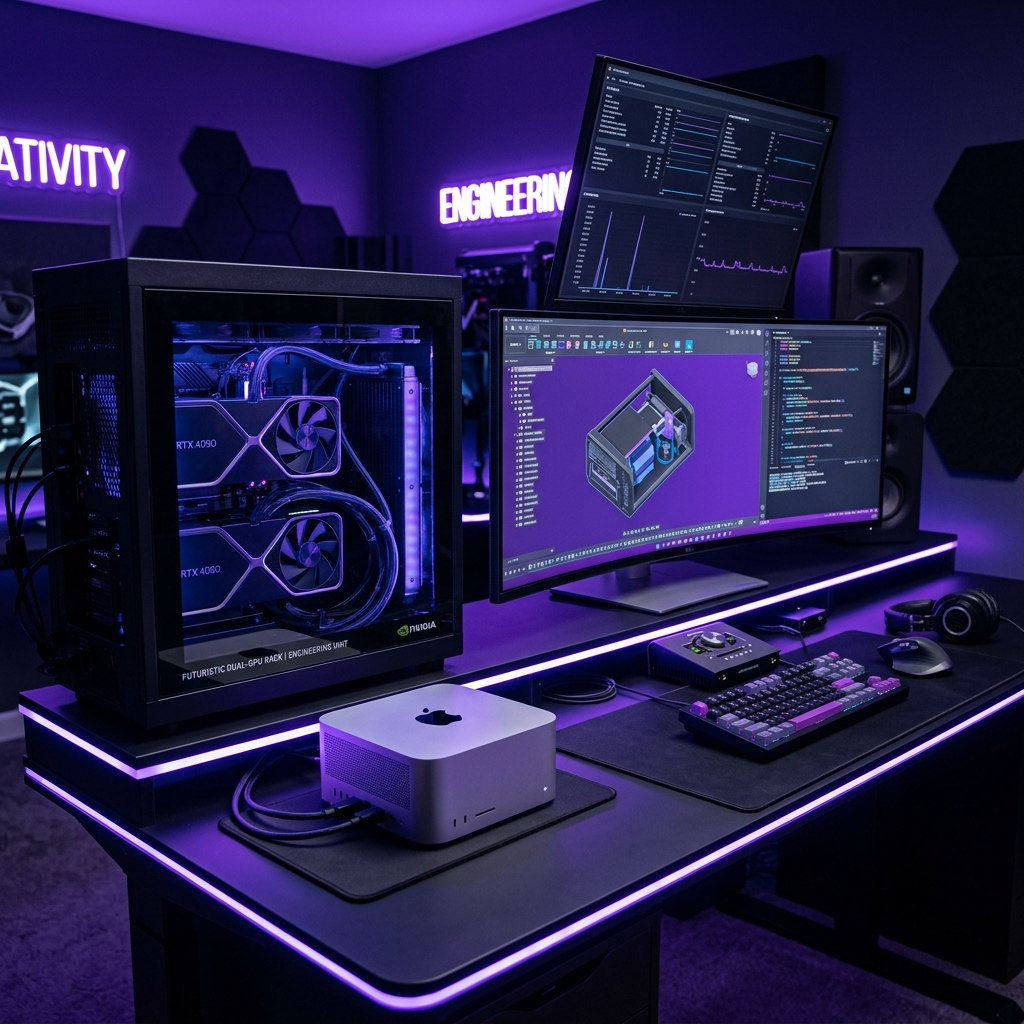
For most businesses and professional developers, the hardware sweet spot falls into two categories:
- Apple Silicon (Mac Studio / MacBook Pro): Large unified-memory configurations can run open-weights models that do not fit on a single consumer GPU. CPU and GPU access the same memory pool, making models such as Llama 3.3 70B practical at suitable quantization levels.
- Dedicated GPU Workstations: Consumer GPUs such as the Nvidia RTX 4090 or RTX 3090 can provide high token throughput. With quantization formats such as AWQ or GGUF, some 27B dense models fit within 24GB of VRAM.
The Open-Weights Champions
Alibaba’s Qwen 3.6 series has emerged as the premier choice for local reasoning and agentic coding:
- Qwen 3.6 27B (Dense): A dense transformer that activates all parameters on every token. Its consistency and reasoning make it a useful workstation model for code generation and codebase analysis.
- Qwen 3.6 35B-A3B (MoE): A Mixture-of-Experts architecture that houses 35 billion total parameters but only activates 3 billion parameters per token. This sparse activation makes it incredibly fast, generating over 50 tokens per second on consumer hardware—perfect for iterative, fast-loop agents.
The Ensemble Shift: OpenRouter Fusion
What if your local models need to match the sheer reasoning depth of a frontier model like Claude Fable 5, but you want to avoid single-vendor cloud lock-in? The answer lies in model ensembles and fusion layers.
Platforms like OpenRouter have pioneered an experimental feature called OpenRouter Fusion (accessible via the openrouter/fusion alias). This approach shifts the paradigm from relying on one monolithic “super-model” to orchestrating a panel of specialized, cheaper models.
U->>F: Send Request
F->>P: Fan out in parallel
P-->>F: Return draft responses
F->>J: Send drafts for review
J-->>F: Return structured analysis & synthesis
F->>U: Deliver final refined response- Parallel Panel Generation: When a user submits a prompt, it is sent in parallel to a “panel” of diverse open-weight models (such as Qwen, Llama, and Gemma).
- Active Deliberation: A high-reasoning “judge” model reviews the generated drafts. It analyzes them for consensus, contradictions, unique angles, and potential hallucination blind spots.
- Synthesis: The judge synthesizes the best elements of the drafts, producing a structured, verified, and highly refined final answer.
Fusion is a real OpenRouter feature, but it should not be confused with automatic truth. Multiple models can repeat the same error, and a judge can still synthesize a confident mistake. Use the panel to expose disagreement and blind spots, then verify important claims against primary sources.
For research and expert critique, the panel-and-judge pattern can be useful when the cost of a few extra completions is lower than the cost of missing an important angle. A private version can spread work across several local models, although it adds latency and operational complexity.
The Practical Conclusion: Keep an Exit Route
Claude Fable 5 did not have a three-day lifespan; it had an 18-day interruption. The distinction matters. Anthropic resolved the immediate problem, but customers could not control the timing.
The sensible response is not to move every workload on-premises. Start by identifying which workflows cannot stop, which data cannot leave your environment, and which model capabilities are genuinely hard to replace. Then test a fallback before you need it.
Use the cloud where it gives you speed and capability. Keep a local or second-provider route for the work that matters most. Resilience is not owning every layer; it is knowing how you will continue when one layer disappears.
At Dataxad, we specialize in helping businesses design and deploy high-performance, local-first AI architectures and agentic workflows. Ready to secure your AI strategy against cloud volatility? Book a consultation with our team today.